Horsetail New · Sep 2026
Equisetum arvense· Field horsetail, Common horsetail, Bottlebrush
Nursery tag says Equisetum arvense (field horsetail). Extremely aggressive spreader — keep it in a container or root barrier, never open ground.
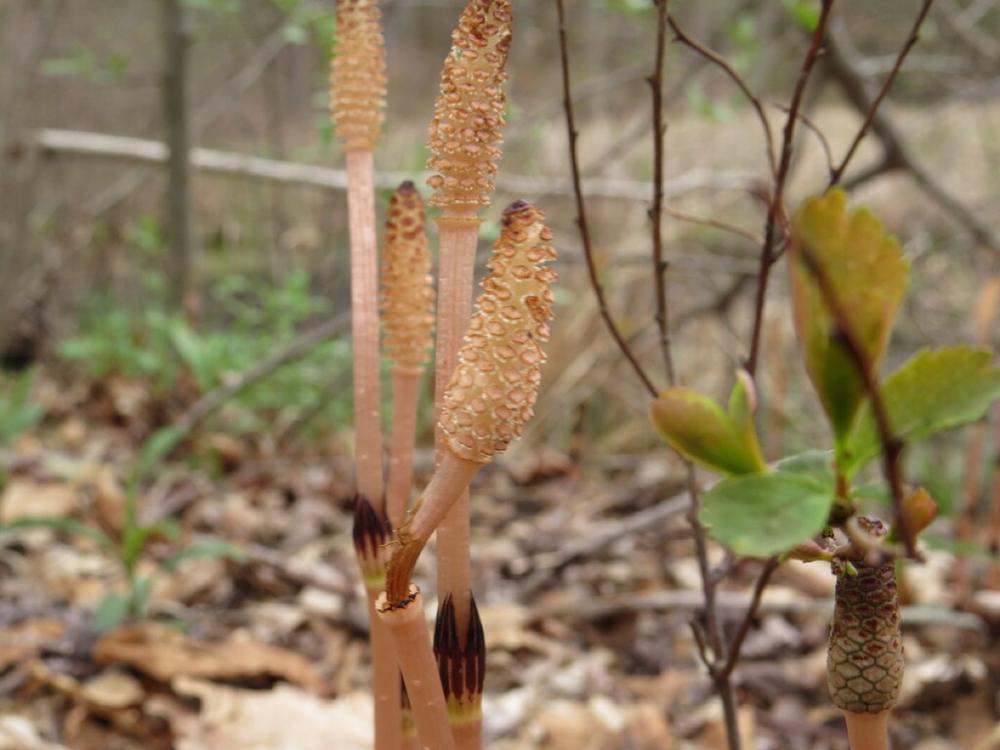 Young
YoungSpring fertile shoots (April): tan, leafless 6-8 in stems topped with spore cones, pushing up through leaf litter before any green growth appears.
Photo: Lee Minicuci· CC BY-NC
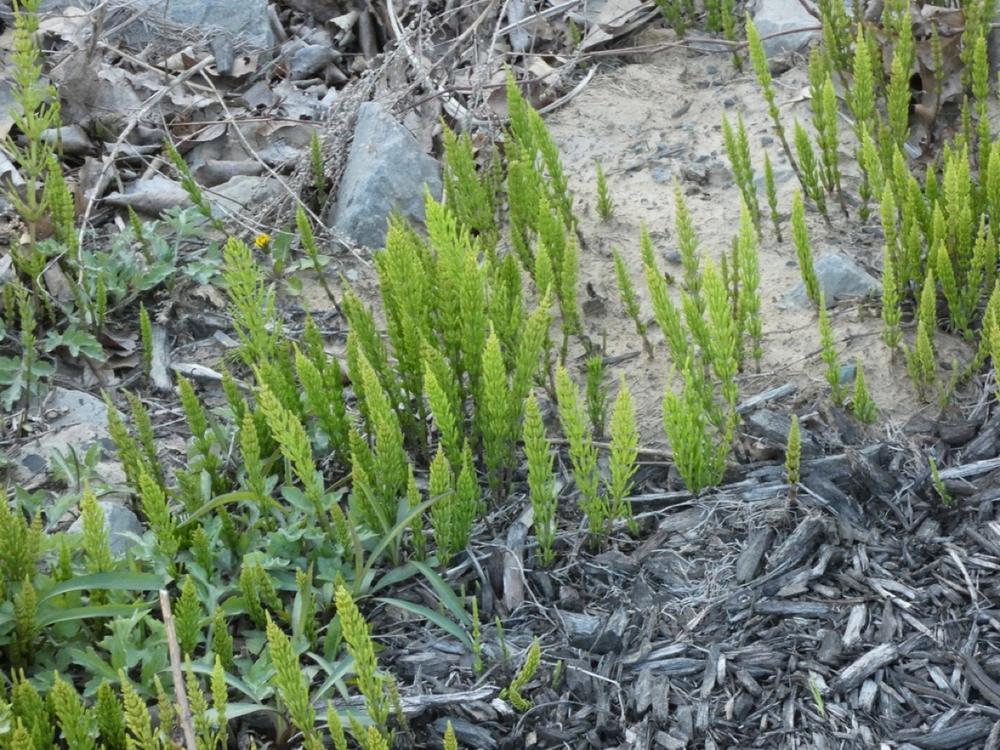 Growing
Late April: a young colony of green sterile shoots 6-10 in tall, branches still short and upright, spreading along a mulched edge.
Photo: coccothraustes_vespertinus· CC BY-NC
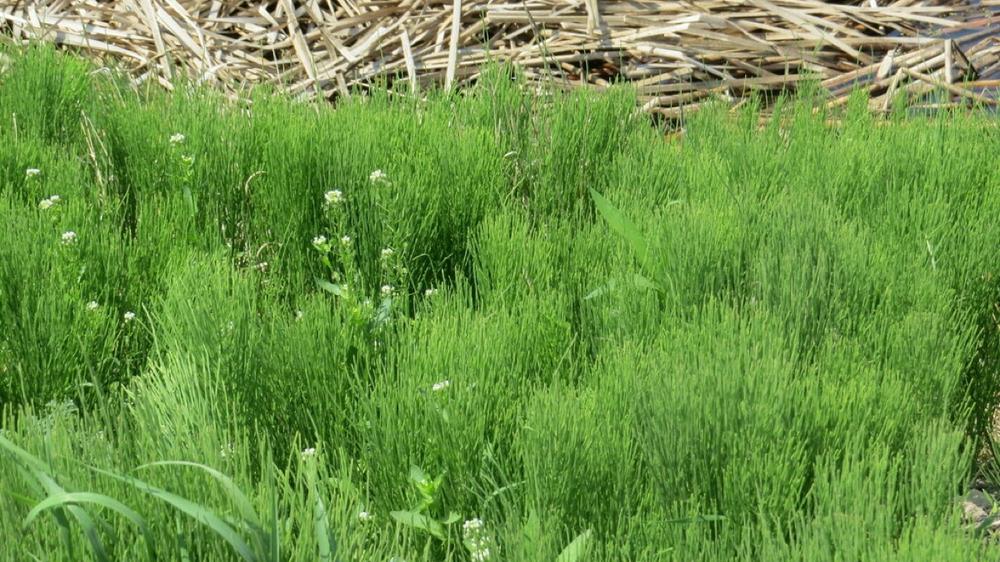 Full grown
Full summer stand (June): a solid knee-high mat of feathery, whorl-branched green stems, which is what an uncontained planting turns into.
Photo: Marilynn Miller· CC BY
Zone 8a: as a contained plant it can be potted any time from March through October; fall (September-October) is fine. Fertile spore shoots appear March-April, green growth April-November.
Growing stages
What to look for, and what to do, at each point in its lifeHorsetail (tagged Equisetum arvense) is a non-flowering, spore-bearing perennial that must be grown only in a sealed container, since its black rhizomes run for many feet and down to 6 feet deep and even a 1-inch fragment regrows into a new colony; it sends up separate tan spore-bearing shoots in March-April before the green, bottlebrush-like sterile growth follows from April to frost, then dies back for a winter cutback.
- 1
Winter Cutback
February, before the tan fertile shoots emergeYou'll see All top growth from last season is brown, collapsed and dead-looking after fall frost.
Do Cut all brown stems down to the soil line in the pot.
- 2
Fertile Spore Shoots
March into AprilYou'll see Tan, leafless, non-photosynthetic shoots 4-10 inches tall push up, each topped by a 1-1.5 inch spore cone (strobilus).
Do Let them stand; no action needed. They shed spores and wither on their own within a few weeks.
- 3
Green Growth Emergence
April into MayYou'll see Green, branched sterile shoots rise from the rhizome, quickly forming the whorled, bottlebrush look the plant is known for.
Do Keep the pot constantly moist to wet; sitting it in 1-2 inches of water in a saucer works well.
- 4
Summer Growth
May through AugustYou'll see Stems reach their full height, typically 1-2 feet, in a dense, feathery, needle-branched stand.
Do Keep the pot constantly wet. A little afternoon shade helps the stems stay green through Decatur's July-August heat.
- 5
Perimeter Check
Spring and again in midsummerYou'll see Any shoot appearing outside the container's rim or through a drainage gap is a sign the rhizome has escaped.
Do Inspect around the pot and pull any escaped shoot immediately, digging out as much of the attached rhizome as you can reach.
- 6
Fall Dieback
October into November, after first frost (~Nov 12)You'll see Green stems brown and collapse, unlike the evergreen unbranched scouring rush sometimes sold under the same common name.
Do No action needed yet; let it die back fully before the winter cutback.
- 7
Division
Spring, every couple of years or when the pot looks crowdedYou'll see The rhizome mass fills and thickens in the pot, potentially cracking a container that is too small.
Do Lift the root mass, slice it into sections with a sharp spade or knife, and repot a piece into a fresh sealed container; discard the rest as trash.
Techniques — transplant, prune, propagate, divide, seed
At a glance
- Botanical name
- Equisetum arvense
- Family
Equisetaceae
- Type
Non-flowering, spore-bearing herbaceous perennial (fern ally); dies back in winter
- Native range
Circumboreal: arctic and temperate Northern Hemisphere. In North America it ranges south to central Georgia, central…
- Hardiness
Zones 3-9
- Height
Spring fertile shoots 4-10 in; green summer sterile shoots 1-2 ft (rarely to 3 ft)
Full sun to part shade; tolerates heavy shade.
Moist to wet. Prefers constantly damp soil; tolerates occasional drying once established…
One plant per container. If you insist on ground planting, 12-36 in apart inside a sealed…
Any texture (clay, loam, sand), pH neutral to alkaline, and it thrives in the wet,…
Care
- Grow it only in a container: a plastic tub or glazed pot at least 12 in deep with no drainage holes into soil (set it in a saucer or a water bowl). Rhizomes run 6 ft deep and escape through drainage holes.
- Keep the pot constantly moist to wet; sitting the pot in 1-2 in of water in a saucer or pond shelf is ideal.
- Site in full sun to part shade; in Decatur a little afternoon shade keeps the stems green through July-August heat.
Good to know
Check what you actually bought. Nurseries almost always sell Equisetum hyemale (scouring rush, rough horsetail) under the name horsetail, and the tag name Equisetum arvense may be wrong. E.
Where it fits
Best alone as a vertical accent in a glazed pot, water bowl or contained bog planter; keep it out of mixed beds entirely.
Harvest
Not a harvest crop. Cut stems for arrangements as the first flowers open; strip lower leaves.
Watch for
Extremely aggressive and one of the hardest weeds to eradicate once loose in soil: deep rhizomes, tubers, tolerance of mowing, pulling and most…
Wildlife & pollinators
Almost no pollinator value (no flowers). In the wild it gives cover and some food to small mammals and waterfowl. Deer and rabbits leave it alone.
Toxicity
Contains thiaminase, which destroys vitamin B1: toxic to horses (equisetosis - weakness, staggering, death) and to cattle and sheep, mostly when…
Propagation
Division of rhizomes in spring (the only practical method); spores in the wild.
General Native / Pollinator Perennial guide
- Fall (Sept–Nov) is the best perennial planting window in Georgia: warm soil grows roots, cool air limits stress, winter rain does the watering.
- Plant at the same depth as the pot; in heavy clay set the crown 1" high and mound soil to it rather than digging a bathtub that holds water.
- Mulch 2" with pine straw or shredded bark, kept an inch off the crown.
- Water deeply 2× a week for the first month even if it rains lightly; the root ball dries faster than the bed around it.
- Leave stems and seed heads standing over winter for birds and overwintering insects; cut back late Feb–early March.
- Divide crowded clumps every 3–4 years in fall or early spring.
- Edit spreaders (rhizomes and self-sown seedlings) each spring while they're small — most natives are generous.
Sources (7)
- https://plants.ces.ncsu.edu/plants/equisetum-arvense/
- https://en.wikipedia.org/wiki/Equisetum_arvense
- https://www.wildflower.org/plants/result.php?id_plant=eqar
- https://plantfinder.mobot.org/plantfinderdetails.aspx?kempercode=c670
- https://en.wikipedia.org/wiki/Equisetum_hyemale
- https://www.invasiveplantatlas.org/subject.html?sub=5587
- https://fsus.ncbg.unc.edu/show-taxon-detail.php?taxonid=86