Mizuna New · Sep 2026
Brassica rapa var. japonica· Mizuna, Kyona, Kyo-mizuna
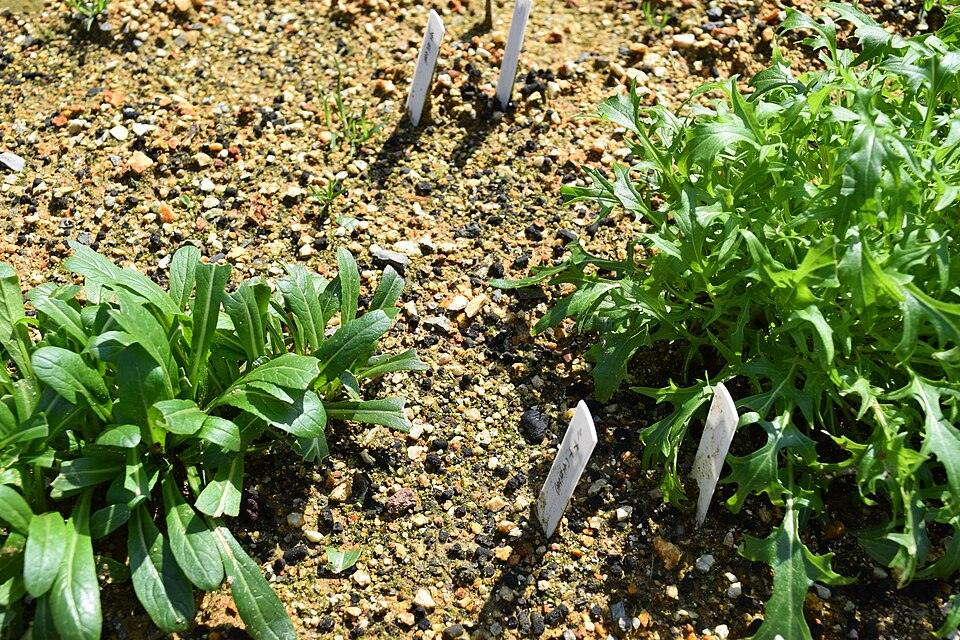 Young
YoungYoung mizuna (right, feathery leaves) and its cousin mibuna (left, strap leaves) a few weeks after sowing in a labeled garden bed; the mizuna rosette is still only 4-6 in across.
Photo: Kingfiser· CC BY-SA 4.0
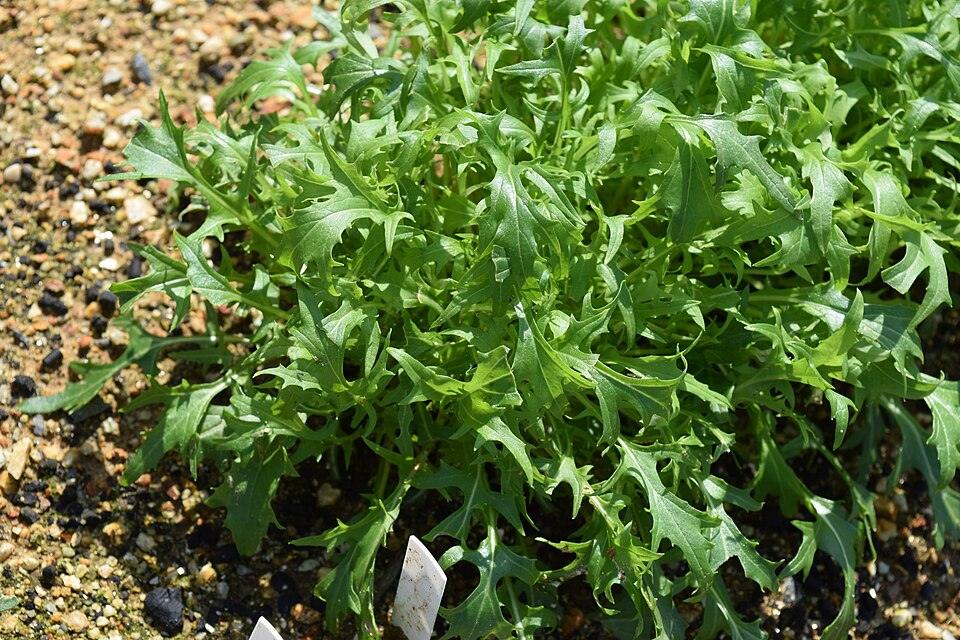 Growing
Half-grown mizuna clump in the garden, roughly 8-10 in across with the characteristic deeply cut leaves; this is about the stage for a first cut-and-come-again harvest.
Photo: Kingfiser· CC BY-SA 4.0
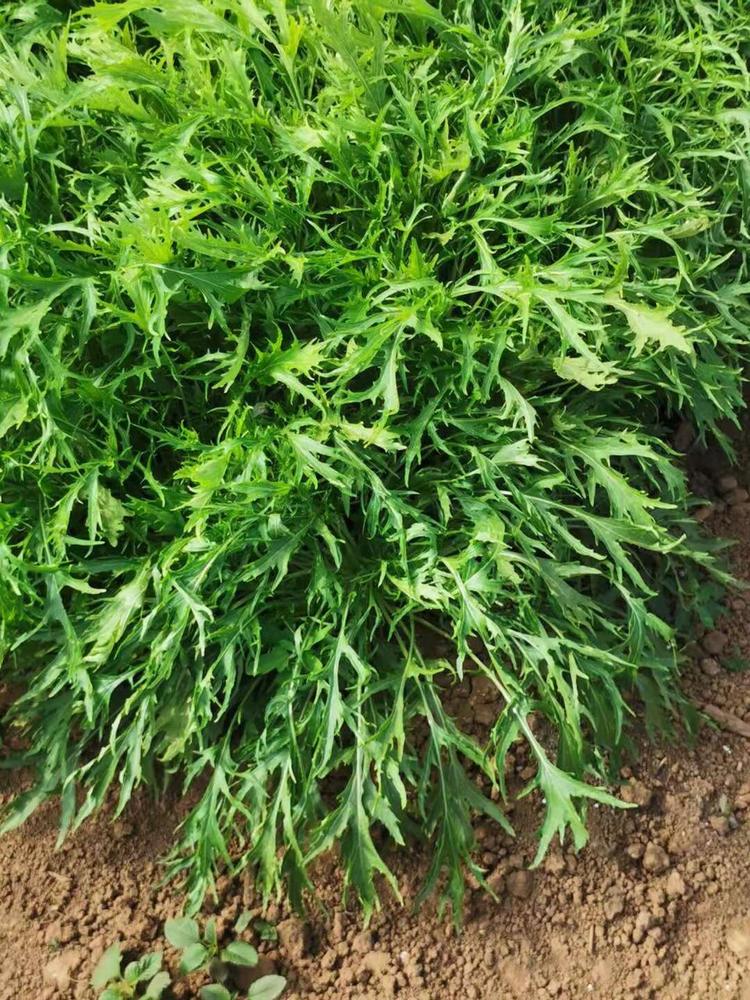 Full grown
Harvest-size Kyo-mizuna in a market garden: dense fountain-shaped clumps of slender white-stemmed, frilly leaves ready to be cut whole or picked leaf by leaf.
Photo: Ping an Chang· CC BY-SA 4.0
Decatur (Zone 8a): direct sow or set transplants from late August through mid-October for fall and winter harvest, and again mid-February through mid-March for a spring crop;
Growing stages
What to look for, and what to do, at each point in its lifeThis group (mizuna, pac choi varieties Rosie F1, Baby Choi, and Prize Choy, and mustards Ruby Streaks, Red Giant, and Southern Giant) follows the same fall-through-spring rhythm as the other greens in Decatur, sown in September for a winter harvest and again in February-March before spring heat pushes them to bolt, but several of these mustards will happily reseed themselves if you let a plant flower.
- 1
Sowing
Early-mid September (fall crop) or mid-February to early March (spring crop)You'll see Seeds are small and round, reddish-brown for mustards and pac choi, and show nothing above ground for several days after sowing.
Do Direct sow 1/4 inch deep, or start pac choi varieties in cell trays for a head start, and keep the surface consistently moist.
- 2
Seedling
Days 4-18 after sowingYou'll see Round seed leaves appear first, then true leaves show each variety's character: mizuna's deeply feathered leaf, pac choi's smooth spoon shape, and the mustards' ruffled, sometimes reddish-purple edges (Ruby Streaks and Red Giant color up early, even as seedlings).
Do Thin to 4-6 inches apart for mizuna and mustards, 6-8 inches for pac choi, and watch for flea beetle shot-holes.
- 3
Transplant
3-4 weeks after starting indoors, when seedlings have 2-3 true leavesYou'll see Transplant-ready pac choi seedlings are compact, 2-3 inches tall, with a small but well-formed rosette and a root ball that holds together.
Do Harden off over 5-7 days, then set plants at the same depth they grew, spaced 8-10 inches apart for pac choi in beds or grow bags.
- 4
Cut-and-come-again harvest
Starting 25-40 days after sowing, continuing 4-8 weeksYou'll see Leaves reach 4-8 inches, with pac choi forming a loose vase-shaped rosette and mustards and mizuna forming a spreading clump of individual leaves.
Do Harvest outer leaves first, or shear the whole plant an inch above the crown for a quick regrow.
- 5
Bolting
Late spring, typically May, once daylength lengthens and temperatures push past 75-80°FYou'll see A central stalk shoots up, leaves become sparse and pointed, and small yellow four-petaled flowers cluster at the top, a classic mustard-family (Brassica) bloom.
Do Harvest what you can before leaves turn bitter, then either pull the plant or leave a few to flower for pollinators and seed.
- 6
Seed saving
4-8 weeks after bolting, once seed pods dry from green to brownYou'll see Flower stalks turn from bright yellow blooms to slim, brown, brittle pods that rattle with seed when dry.
Do Cut dry seed stalks into a paper bag, finish drying, then crush and winnow to collect seed; note which varieties are worth saving.
Techniques — transplant, prune, propagate, divide, seed
At a glance
- Botanical name
- Brassica rapa var. japonica
- Family
Brassicaceae (mustard family)
- Type
Cool-season annual (biennial) leafy vegetable
- Native range
A cultivated form of Brassica rapa that was developed in Japan (traditionally around Kyoto, hence Kyo-na or…
- Hardiness
Zones Grown as an annual in all zones; overwinters outdoors in Zones 7-10 (reliably in Zone 8a with row cover)
- Height
10-18 in (leaf rosette); 2-3 ft when it bolts and flowers
Full sun (6+ hours) for fastest growth; tolerates part shade, and afternoon shade helps…
Consistent moisture, about 1 in per week; shallow roots dry out fast in Georgia's…
Baby leaf: broadcast or sow 3-5 seeds per inch in rows 2 in apart, 1/4 in deep.
Fertile, well-drained soil with plenty of organic matter, pH 6.0-7.5.
Care
- Sow 1/4 in deep in moist soil; seedlings emerge in 3-7 days. For fall sowings in early September, shade the bed or water twice daily until plants are up, because germination stalls in soil above 85 F.
- Thin to final spacing when plants have 3-4 true leaves; the thinnings are salad-ready.
- Side-dress lightly with a nitrogen source (fish emulsion or 1/2 cup of blood meal per 10 ft of row) about 3 weeks after emergence and again after each heavy cut-and-come-again harvest.
Good to know
One of the best greens for the Decatur fall-winter garden: it grows fast, tolerates both the last heat of September and the frosts of December, and can be cut repeatedly.
Where it fits
Fits anywhere in the cool-season bed: interplant between slower brassicas (collards, kale), tuck into the shade of trellised peas in spring, or grow in grow bags and window boxes.
Harvest
Start harvesting baby leaves at 3-4 in tall (about 3 weeks). For cut-and-come-again, cut the whole clump with a knife 1-2 in above the crown, leaving…
In the kitchen
Mild, slightly peppery and crisp; the tenderest of the mustard-type greens.
Watch for
Flea beetles (shot-holed leaves) are the number-one pest in Georgia, especially on late-summer sowings; row cover from day one is the fix.
Wildlife & pollinators
Larval host for cabbage white butterflies and cabbage loopers, which is why row cover matters.
Toxicity
None known; safe for people and pets in normal food amounts. Like all brassicas it contains goitrogens and can cause gas or mild stomach upset in…
Propagation
Seed only. Open-pollinated; it will cross with other Brassica rapa crops (pac choi, turnips, napa, Chinese mustard) if several flower together, so…
General Asian Greens / Mustards guide
- Transplant in the evening; shade cloth the first 3–5 days if highs are above 85°F.
- Row cover (AG-19) from day one keeps cabbage worms, flea beetles and harlequin bugs off — the #1 fall greens fix.
- Sow a new short row every 2–3 weeks through October for a continuous harvest.
- Harvest outer leaves and let the center keep producing (cut-and-come-again); or cut whole plants 1" above the crown and they'll regrow once.
- Mustards and mizuna shrug off frost and freezes into the low 20s; pac choi needs row cover below ~28°F.
- Let one plant bolt in spring — the yellow flowers feed bees and the seed comes true for open-pollinated types.
Sources (7)
- https://www.johnnyseeds.com/vegetables/greens/asian-greens/mizuna-organic-asian-green-seed-2883.html
- https://www.johnnyseeds.com/growers-library/vegetables/baby-leaf/baby-leaf-brassicas-key-growing-information.html
- https://extension.psu.edu/mizuna-an-asian-green
- https://hort.extension.wisc.edu/articles/growing-salad-greens-wisconsin/
- https://fieldreport.caes.uga.edu/publications/C1258/
- https://plants.ces.ncsu.edu/plants/brassica-rapa-chinensis-group/
- https://www.sustainablemarketfarming.com/tag/ruby-streaks/