Amish Snap Pea New · Sep 2026
Pisum sativum 'Amish Snap'· Amish Snap pea, snap pea, sugar snap-type pea
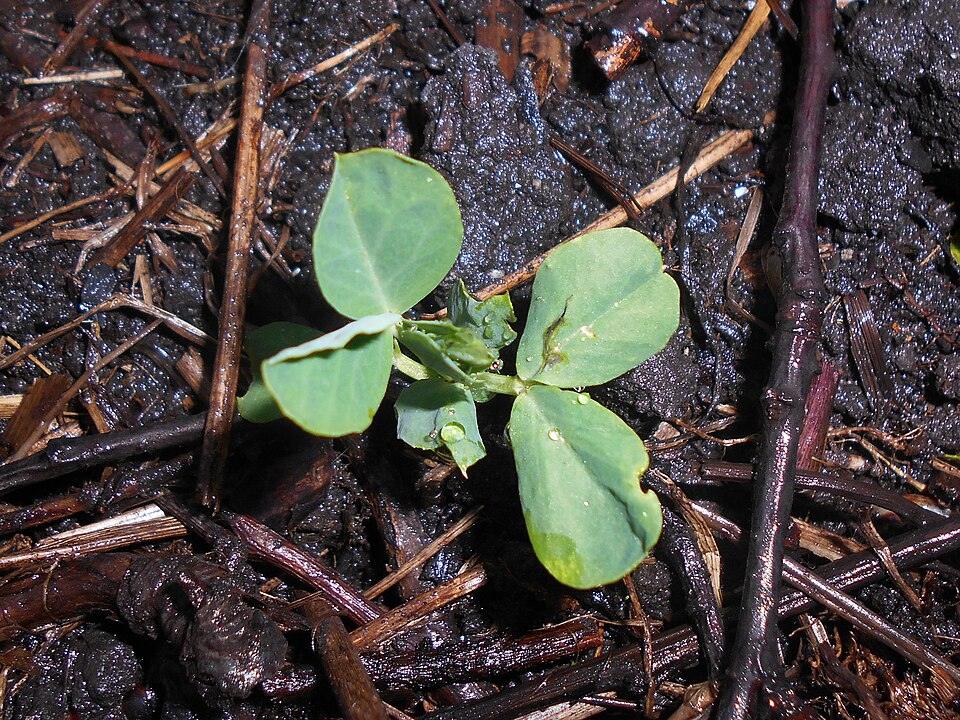 Young
YoungPea seedling (Pisum sativum var. macrocarpum, the edible-podded group) about two weeks after emergence, showing the first pinnate leaves and stipules
Species-level photo (not this exact cultivar).
Photo: Salicyna· CC BY-SA 4.0
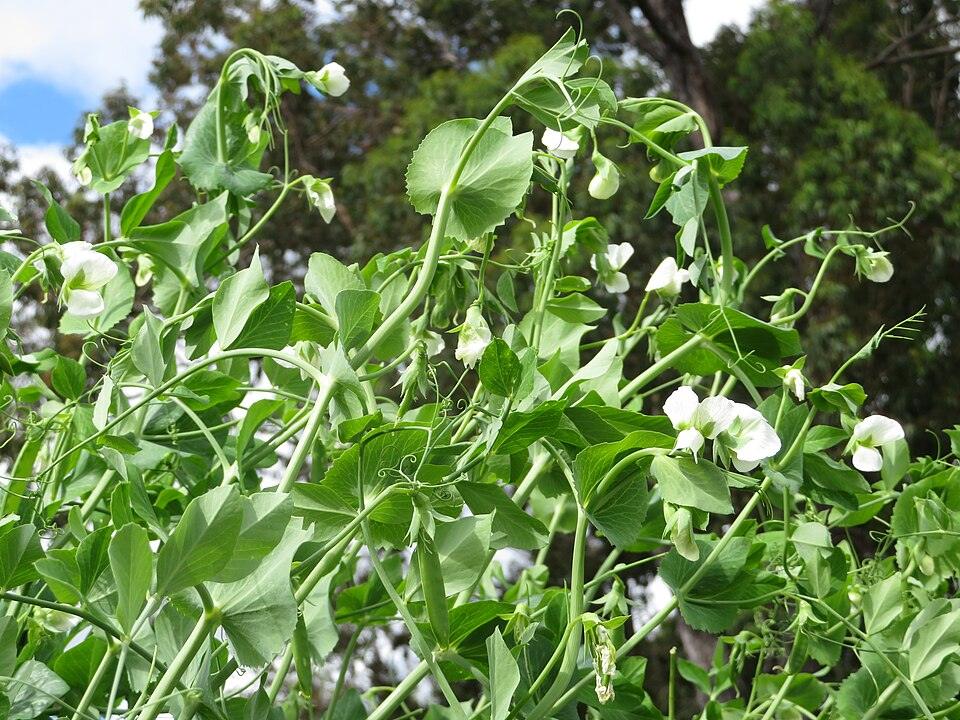 Growing
Edible-podded pea vines climbing and just coming into white flower (Forest and Kim Starr, Maui); Amish Snap flowers are white like these
Species-level photo (not this exact cultivar).
Photo: Forest and Kim Starr· CC BY 2.0
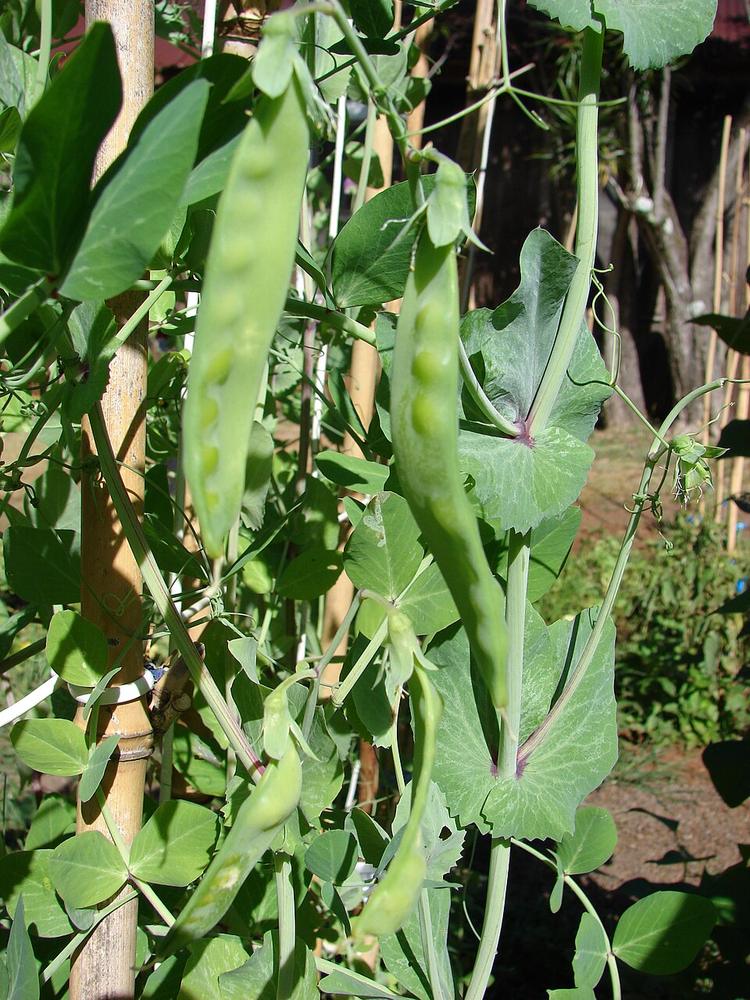 Full grown
Plump edible pods hanging from bamboo-staked pea vines at picking size (Forest and Kim Starr, Maui)
Species-level photo (not this exact cultivar).
Photo: Forest and Kim Starr· CC BY 3.0 us
Decatur GA Zone 8a: two sowing windows. FALL: sow about Sept 1-20 (Clemson lists Aug 15-Oct 30 for the Piedmont, but with 60-70 days to maturity and a mid-November first frost the earlier you sow in September the more…
Growing stages
What to look for, and what to do, at each point in its lifeAmish Snap and Golden Sweet peas go into Luke's Decatur garden twice a year, a late-summer sowing for a fall crop and a Feb-to-early-March sowing for a spring crop, climbing a trellis by tendrils through cool weather, offering pea shoots as an early bonus harvest, cropping pods for several weeks, and finishing either at hard frost in fall or as heat shuts vines down in late spring.
- 1
Fall Direct Sowing
Zone 8a fall window: late summer to early fall, roughly late August through September, about 10-12 weeks before the first hard frost (~Nov 12).You'll see A prepared bed or grow bag with pea seed pressed about 1 inch deep, spaced 2-3 inches apart along a trellis line.
Do Direct-sow seed for a fall crop while soil is still warm, watering carefully since fall sowing often means germinating in leftover summer heat.
- 2
Late Winter Direct Sowing
Zone 8a spring window: mid-February through early March, about 4-6 weeks before the last frost (~Mar 28).You'll see Bare, cool soil with seed sown at the same depth and spacing as the fall crop.
Do Direct-sow as soon as soil can be worked in mid-to-late winter; do not wait for the last frost date, since peas are cold-hardy and germinate fine in cool soil.
- 3
Seedling
Days 7-14 after either sowing, depending on soil temperature.You'll see A pair of thick seed leaves gives way to the first true compound leaves with small leaflets and a thin, curling tendril at the tip.
Do Keep the trellis or netting close at hand; young tendrils start reaching for support almost as soon as the first true leaves appear.
- 4
Vining and Trellising
Weeks 3-6 after sowing.You'll see A climbing vine with compound leaves ending in branched, wiry tendrils that coil tightly around any thin support they touch, pulling the plant upward.
Do Guide young vines onto the trellis or netting as needed; tendrils do most of the climbing work on their own once they find something to grip.
- 5
Pea Shoot Harvest
Any time vines are 8-12 inches tall or more, taken sparingly alongside other growth.You'll see Tender young growing tips 2-6 inches long with 2-4 pairs of small leaves, a curling tendril, and sometimes an unopened flower bud at the very end.
Do Snip a few growing tips per plant with scissors or garden snips for a fresh, pea-flavored green, taking care not to strip so many tips that the vine's climbing and flowering are set back.
- 6
Flowering
Roughly 30-45 days after sowing, varying with temperature.You'll see Amish Snap produces white flowers typical of a Butterpea-type snap pea; Golden Sweet produces showy bicolor purple-and-white blooms typical of many colorful snow pea varieties, both appearing in leaf axils along the vine.
Do No pollination help needed. Protect open flowers from hard freezes if a late cold snap threatens during fall or late-winter flowering.
- 7
Pod Harvest
Roughly 60-70 days after sowing, continuing for several weeks.You'll see Golden Sweet forms flat, bright yellow snow pea pods harvested while still flat before the peas inside swell; Amish Snap forms plump, translucent green snap pea pods harvested once the peas inside have filled out but the pod is still tender and sweet.
Do Pick Golden Sweet pods while still flat for classic snow pea texture; pick Amish Snap pods once rounded and full but before they toughen. Harvest both every 1-2 days to keep vines producing.
- 8
Seed Saving
Late in a planting's life, leaving a few pods on the vine to dry fully rather than picking them for eating.You'll see Chosen pods left on the vine swell, then dry and fade to tan or brown, becoming papery and rattly with hardened peas inside.
Do Let selected pods dry completely on the vine, then pick, shell, and finish drying the peas indoors before storing.
- 9
End of Season
Fall crop: killed by hard frost, typically around Nov 12. Spring crop: shuts down as temperatures rise into the 80s, typically late May to June.You'll see Fall vines blacken and collapse within a day or two of a hard freeze. Spring vines yellow, stop flowering, and pods toughen quickly as heat sets in.
Do Pull spent vines after frost (fall crop) or once heat has clearly ended production (spring crop), leaving root nodules in the soil, and clear the trellis for its next use.
Techniques — transplant, prune, propagate, divide, seed
At a glance
- Botanical name
- Pisum sativum 'Amish Snap'
- Family
Fabaceae (pea family)
- Type
Cool-season annual vegetable; tall vining legume grown on a trellis
- Native range
Garden pea is an Old World crop domesticated in the Near East and Mediterranean (Eurasia);
- Hardiness
Zones Grown as an annual in all zones; in Zone 8a it is a fall and late-winter/spring crop
- Height
5-6 ft vines (must be trellised)
Full sun (6+ hours). Fall sowings in Decatur benefit from afternoon shade or shade cloth…
Even moisture, about 1 in per week; critical during germination and again during…
Sow seed 1-1.5 in deep, 1-2 in apart (8-10 seeds per foot) in a single or double row on…
Well-drained loam, pH 6.0-7.0 (Clemson recommends 6.0-6.5). Tolerates Georgia clay if the…
Care
- Install the trellis (5-6 ft netting, cattle panel, or chicken wire) at sowing time; vines climb on their own but need the support in place before they flop.
- Early-September sowings go into 80 F soil: pre-sprout seed 24-48 hours in damp paper towel, sow in the evening, mulch lightly, and keep the seedbed moist; use 30 percent shade cloth for the first 2-3 weeks if it is still in the 90s.
- Dust seed with a pea/bean inoculant (Rhizobium leguminosarum) the first time you grow peas in a bed; skip high-nitrogen fertilizer, which gives vines instead of pods.
Good to know
Amish Snap predates the modern Sugar Snap (1979) and was grown in Amish communities for generations; Seed Savers Exchange, Fedco and other heirloom houses carry it.
Where it fits
Pairs well along a trellis with a row of lettuce, spinach, radishes or cilantro at its feet, which enjoy the shade of the vines;
Harvest
Snap pea: pick when pods are plump and rounded (about 2-3 in long for this variety) but before the seeds bulge individually or the pod dulls to…
In the kitchen
Sweet, juicy, tender-crisp whole pods with a distinct old-fashioned pea flavor; eaten raw, in salads, stir-fried, or blanched 30-60 seconds.
Watch for
Powdery mildew in warm humid weather (worse on spring crops that run into May;
Wildlife & pollinators
Self-pollinating but visited by bumblebees and small native bees. Peas fix nitrogen for the soil.
Toxicity
None known. Garden pea (Pisum sativum) is listed by the ASPCA as non-toxic to dogs and cats;
Propagation
Direct-sown seed only (transplants resent root disturbance). Open-pollinated heirloom, so you can save seed: let pods dry brown on the vine, shell,…
General Snap / Snow Pea guide
- Zone 8a gets two pea seasons: sow Sept 1–25 for a fall crop (harvest Nov–Dec under cover) and again Jan 25–Feb 20 for spring.
- Direct sow only — peas resent transplanting. Soak seed 8–12 hrs first.
- Install the trellis (6–7 ft for these tall heirlooms) before sowing; guide the first tendrils onto it.
- Mulch after emergence to keep roots cool and moist.
- Vines survive to ~25°F but open flowers and young pods are damaged by frost — drape row cover on frosty nights.
- Pick every 1–2 days once pods size up; overmature pods signal the plant to quit.
- Leave roots in the soil when the crop is done for the nitrogen nodules.
Used in 2 recipes
Sources (7)
- https://shop.seedsavers.org/amish-snap-pea
- https://mother-earth-gardens-webstore.myshopify.com/products/pea-snap-amish-snap-seed-savers-exchange
- https://fedcoseeds.com/seeds/amish-snap-pea-885
- https://hgic.clemson.edu/factsheet/garden-peas/
- https://plants.ces.ncsu.edu/plants/pisum-sativum/
- https://sites.udel.edu/weeklycropupdate/?p=19860
- https://www.aspca.org/pet-care/animal-poison-control/toxic-and-non-toxic-plants