Egyptian Walking Onion New · Sep 2026
Allium x proliferum· Egyptian walking onion, Tree onion, Top onion
Ordered Sept 12, ships this fall. A perennial you plant once: give it a permanent 2 × 2 ft spot (allium station or a bed corner that never gets turned). Top-sets fall over and root themselves — that's the 'walking'.
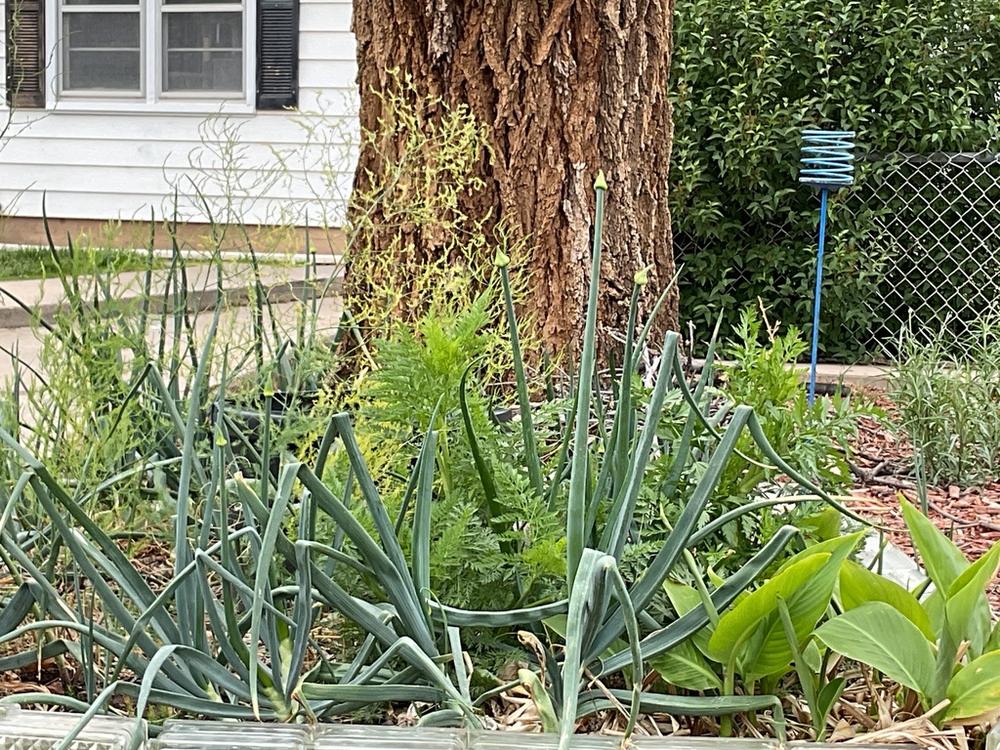 Young
YoungFresh green shoots of Egyptian walking onion emerging from the clump in spring, before flower/topset stalks form
Photo: Jean Stuntz· CC BY-NC
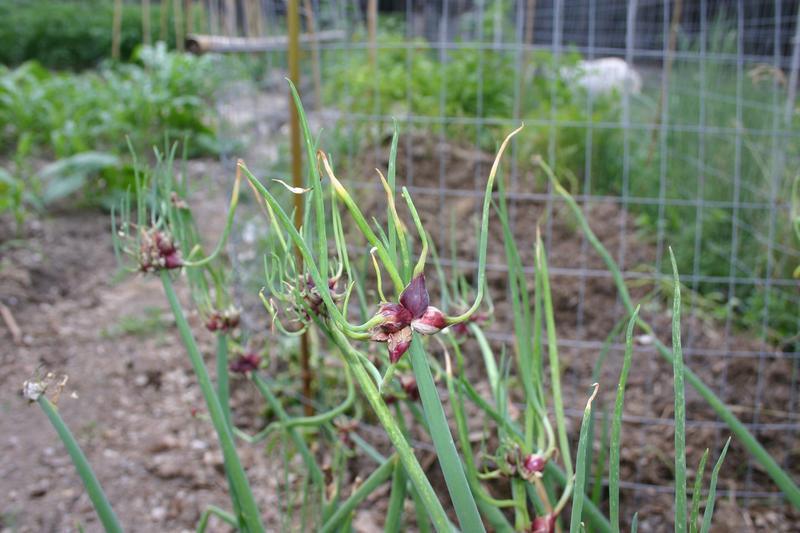 Growing
Established clump with stalks forming clusters of purple-tinged topsets (bulbils) at the stem tips
Photo: Dave Whitinger· CC BY-SA 3.0
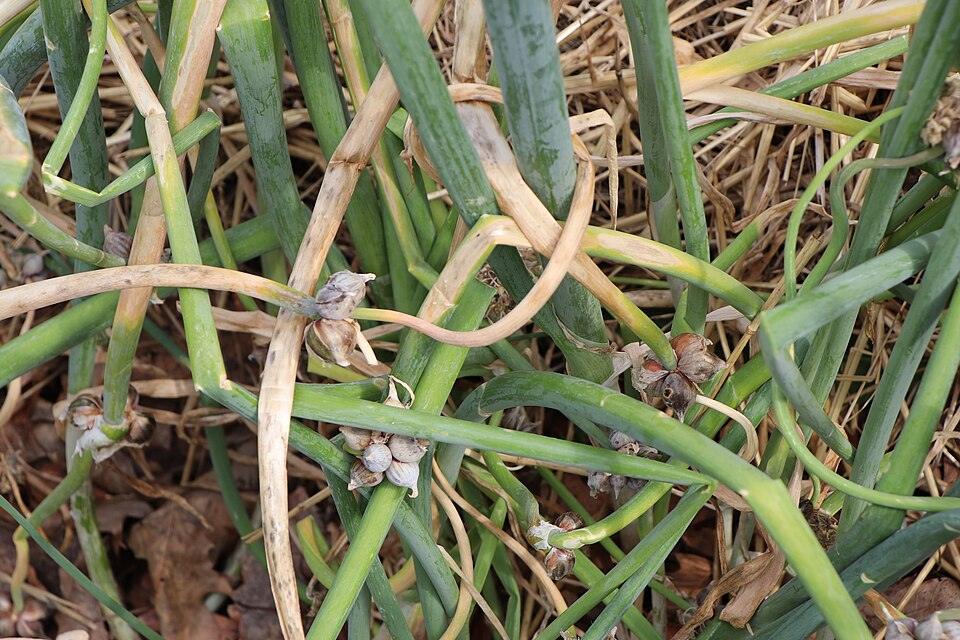 Full grown
Mature, fully formed clusters of papery-skinned walking onion bulbils on arching stalks, ready to topple over and root - the 'walking' habit
Photo: NPS· Public domain
In Decatur (Zone 8a), plant bulbils in fall - mid-October through November is ideal, once soil has cooled but before hard frost, so roots establish over the mild winter.
Growing stages
What to look for, and what to do, at each point in its lifeEgyptian walking onion is a permanent perennial in Luke's Decatur garden: planted once from fall bulbils or divisions, it spends its first year mostly building roots and clump size, then from its second year on it produces spring scallions, summer topset bulbils, and fall bulbs indefinitely while slowly walking itself a foot or two across the bed each season.
- 1
Planting bulbils or divisions
Sept-Oct in Zone 8a, 6-8 weeks before first frost (around Nov 12)You'll see Bulbils look like small papery-skinned onions, 0.5-1 inch across, sometimes still clustered in a loose topset head with a few dried stem fragments attached. Whole clump divisions look like a fan of 3-6 slim white onion bases with roots and a few inches of green top.
Do Plant bulbils or divisions now so roots establish before winter cold sets in.
- 2
First-year establishment
Fall through the following spring, roughly Oct-May of year oneYou'll see You'll see mostly a modest tuft of upright, hollow, blue-green leaves, 8-14 inches tall, thickening slowly at the base. There's little to no flowering or topset activity this first year -- the plant is putting its energy underground.
Do Let it grow undisturbed; harvest only lightly if at all this first year.
- 3
Spring green (scallion) harvest
Year two onward, March-MayYou'll see Clumps send up a flush of thick, hollow, scallion-like green shoots, often a dozen or more per established clump, each 10-18 inches tall with a mild onion smell when bruised.
Do Cut some of the outer shoots at soil level for scallion use without killing the plant.
- 4
Scape and topset formation
Early to mid summer, roughly June-JulyYou'll see Thick, rounded, hollow flower-stalk-like scapes rise 2-3 feet above the leaves. Instead of true flowers, each scape tip swells into a knobby green cluster that develops into a bunch of small bulbils -- the topsets -- sometimes with a few thread-like bulbils or a wispy flower or two mixed in.
Do Let the topsets develop and plump up on the plant; don't harvest the scapes yet.
- 5
Topset harvest and the walk
Mid-late summer, roughly July-AugustYou'll see By now the scape is fully arched or even lying on the ground, and the topset bulbils are firm, plump, and papery-skinned. Where a cluster has touched soil, you may already see thin white roots emerging from the bulbils into the ground.
Do Harvest most of the topsets for pickling or replanting stock, but leave a few clusters where they land so the clump can walk.
- 6
Fall/winter underground bulb harvest
Fall into early winter, roughly Oct-Dec, after top growth dies backYou'll see Top growth yellows and dies back with the season's first real cold snaps. Below ground, each division has swollen into a small, elongated onion bulb, stronger-flavored and more pungent than the green tops.
Do Dig a portion of the clump for its underground bulbs, leaving enough of the clump in place to regrow.
- 7
Dividing the mature clump
Every 3-4 years, ideally fall or very early springYou'll see An undivided clump becomes crowded -- you'll see a dense mat of bulbs and shoots competing for space, smaller individual shoots, and reduced topset production compared to a fresh clump.
Do Dig the whole clump and split it into smaller fans of 3-6 bulbs each, replanting at the original spacing.
Techniques — transplant, prune, propagate, divide, seed
At a glance
- Botanical name
- Allium x proliferum
- Family
Amaryllidaceae (Allioideae)
- Type
Herbaceous perennial allium / perennial vegetable
- Native range
Not native to North America; believed to be a natural hybrid between common onion (Allium cepa) and Welsh onion (Allium…
- Hardiness
Zones 3-9 (reliably perennial in Decatur's Zone 8a)
- Height
1.5-3 ft in leaf; flowering/bulbil stalks can reach 2-4 ft, then arch over under the weight of the topsets
Full sun to part sun (6+ hours ideal); tolerates light afternoon shade, especially useful…
Average, consistent moisture, roughly 1 inch/week while actively growing;
Plant bulbils 4-6 inches apart within a clump, rows or clump centers 12-18 inches apart…
Adaptable; prefers well-drained loam with pH 6.0-7.0 but tolerates average fertility and…
Care
- Plant bulbils pointed-end up, about 1-2 inches deep in Georgia's mild-winter Zone 8a (deeper, up to 3-4 inches, is only needed in much colder climates)
- Mulch with 2-3 inches of straw or leaf mulch after fall planting to moderate soil temperature and suppress weeds; it also keeps the clay soil from crusting
- Choose a permanent, out-of-the-way spot (bed edge, herb garden, food forest guild) since this onion is not part of normal crop rotation and will spread on its own for years
Good to know
This is the one true 'plant it once, harvest forever' onion in the garden - the whole point of Luke's order is a permanent, unfussed-with patch rather than a rotated annual crop.
Where it fits
Good in a permanent herb or perennial-vegetable guild alongside chives, garlic, and other alliums, or as a pest-deterrent edging near brassicas, carrots, and roses;
Harvest
Three edible parts, at different times: (1) Greens - snip like scallions/chives any time the foliage is up, but especially late winter through spring…
In the kitchen
Mild oniony-garlicky flavor. Greens work anywhere scallions do - stir-fries, egg dishes, salads, garnishes, scallion pancakes.
Watch for
Very few serious pests or diseases; watch for onion thrips, allium leaf miner (an increasing concern in the mid-Atlantic/Southeast), and occasional…
Wildlife & pollinators
Minor pollen/nectar value if a few true flowers open among the topsets, but it's not a significant pollinator plant.
Toxicity
Toxic to dogs and cats (and other pets/livestock) like all Allium species - ingestion can cause oxidative damage to red blood cells and hemolytic…
Propagation
Almost entirely vegetative: plant bulbils from the topsets, or divide the clustered underground bulbs in fall.
General Allium (Onion / Garlic / Scallion / Chive) guide
- Cut garlic/onion scapes immediately to redirect energy to bulbs.
- Fall planting: order seed garlic/onions July–Aug; plant in October for next year.
- Evergreen bunching onion is perennial; harvest outer stalks and it regrows.
Used in 9 recipes
Sources (7)
- https://blog.southernexposure.com/2026/07/how-to-grow-egyptian-walking-onions/
- https://gardenerspath.com/plants/vegetables/grow-egyptian-walking-onions/
- https://garden.org/plants/view/658867/Egyptian-Walking-Onion-Allium-x-proliferum/
- https://sowtrueseed.com/blogs/planting/egyptian-walking-onions-a-perennial-wonder-crop
- https://extension.psu.edu/programs/master-gardener/counties/lycoming/news/egyptian-walking-onions
- https://www.merckvetmanual.com/toxicology/food-hazards/garlic-and-onion-allium-spp-toxicosis-in-animals
- https://www.dvm360.com/view/toxicology-brief-allium-species-poisoning-dogs-and-cats